Serialization is the process of converting a data structure or object into a sequence of bits so that it can be stored in a file or memory buffer, or transmitted across a network connection link to be reconstructed later in the same or another computer environment.
Design an algorithm to serialize and deserialize a binary tree. There is no restriction on how your serialization/deserialization algorithm should work. You just need to ensure that a binary tree can be serialized to a string and this string can be deserialized to the original tree structure.
Clarification: The input/output format is the same as how LeetCode serializes a binary tree. You do not necessarily need to follow this format, so please be creative and come up with different approaches yourself.
Example 1:
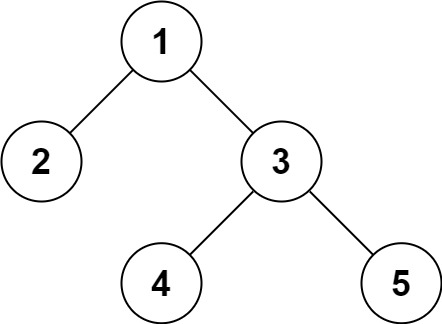
Input: root = [1,2,3,null,null,4,5]
Output: [1,2,3,null,null,4,5]
Example 2:
Input: root = []
Output: []
Constraints:
- The number of nodes in the tree is in the range
[0, 104]. -1000 <= Node.val <= 1000
解题思路
二叉树的序列化本质上是对其值进行编码,更重要的是对其结构进行编码。可以遍历树来完成上述任务。众所周知,我们一般有两个策略:广度优先搜索和深度优先搜索。
广度优先搜索可以按照层次的顺序从上到下遍历所有的节点 深度优先搜索可以从一个根开始,一直延伸到某个叶,然后回到根,到达另一个分支。根据根节点、左节点和右节点之间的相对顺序,可以进一步将深度优先搜索策略区分为: 1. 先序遍历 2. 中序遍历 3. 后序遍历
如Example 1的树,采用先序遍历我们可以得到字符串: 1, 2, None, None, 3, 4, 5
None表示子节点不存在,因此该字符串就保留了树的结构。
该序列化方法的时间复杂度为O(N),因为我们只会访问每个节点一次。空间复杂度也为O(N).
反序列化的过程我们先把字符串根据“,”拆分,然后从左往右遍历元素。
序列化函数和反序列化函数都可以用递归思想。
# Definition for a binary tree node.
# class TreeNode(object):
#     def __init__(self, x):
#         self.val = x
#         self.left = None
#         self.right = None

class Codec:

    def serialize(self, root):
        """Encodes a tree to a single string.

        :type root: TreeNode
        :rtype: str
        """
        if root==None:
            return '#,'
        left=self.serialize(root.left)
        right=self.serialize(root.right)
        return str(root.val)+','+left+right


    def deserialize(self, data):
        """Decodes your encoded data to tree.

        :type data: str
        :rtype: TreeNode
        """
        return self.buildTree(data.split(','))

    def buildTree(self,data):
        val=data.pop(0)
        if val=='#':
            return None
        node=TreeNode(val)
        node.left=self.buildTree(data)
        node.right=self.buildTree(data)
        return node

# Your Codec object will be instantiated and called as such:
# ser = Codec()
# deser = Codec()
# ans = deser.deserialize(ser.serialize(root))