Given an input string s and a pattern p, implement regular expression matching with support for '.' and '*' where:
'.'Matches any single character.'*'Matches zero or more of the preceding element.
The matching should cover the entire input string (not partial).
Example 1:
Input: s = "aa", p = "a"
Output: false
Explanation: "a" does not match the entire string "aa".
Example 2:
Input: s = "aa", p = "a*"
Output: true
Explanation: '*' means zero or more of the preceding element, 'a'. Therefore, by repeating 'a' once, it becomes "aa".
Example 3:
Input: s = "ab", p = ".*"
Output: true
Explanation: ".*" means "zero or more (*) of any character (.)".
Constraints:
1 <= s.length <= 201 <= p.length <= 30scontains only lowercase English letters.pcontains only lowercase English letters,'.', and'*'.- It is guaranteed for each appearance of the character
'*', there will be a previous valid character to match.
解题思路
手写最简单的正则表达式函数,判断s是否符合p的正则规则。
初始思路
用两个指针分别读取s和p的头,按照规则依次匹配。确保两个指针可以在满足规则的前提下都移动到s和p的尾端。
进阶思路
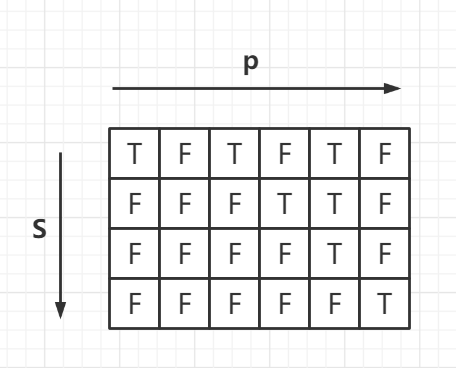
动态规划。类似于两个序列做比对,只要可以完全alignment上就OK。
class Solution:
    def isMatch(self, s, p):
        m = len(s) + 1
        n = len(p) + 1
        dp = [[False for _ in range(n)] for _ in range(m)]
        dp[0][0] = True
        for j in range(2, n):
            if p[j-1] == '*':
                dp[0][j] = dp[0][j - 2]
        for r in range(1, m):
            i = r - 1
            for c in range(1, n):
                j = c - 1
                if s[i] == p[j] or p[j] == '.':
                    dp[r][c] = dp[r - 1][c - 1]
                elif p[j] == '*':
                    if p[j - 1] == s[i] or p[j - 1] == '.':
                        dp[r][c] = dp[r - 1][c] or dp[r][c - 2]
                    else:
                        dp[r][c] = dp[r][c - 2]
                else:
                    dp[r][c] = False
        return dp[m - 1][n - 1]